The era of Physical AI. Will robots end up replacing us?
Why all of Silicon Valley is talking about robots, and what I would question before buying it.
If you go to Silicon Valley, you will end up hearing a term that is now everywhere: Physical AI.
In short, it is everything related to robotics: companies trying to get us robots across different verticals that automate a large part of physical work.
And if that is achieved, now robots really would leave us without jobs. At least, any job we can think of for now.
In 2026 it became the trendy topic, and in this essay I want to explain why, but also what I would question.
Before we start, and in the spirit of critical thinking, I invite you not to take what is written here as the truth, but as something that pushes you to research on your own and test it against your own judgment.
In July 2025 we were exploring entering the human data market. Basically: collecting, labeling, and selling data to companies that train models.
In the end it did not happen, but it led me to learn about the bet some companies like Physical Intelligence are making: generalist foundation models for robotics. That is, one "brain" that works for different robots and different tasks.
At that point Physical AI was already somewhat trendy, but not at today's level. My curiosity led me to ask myself: why?
What LLMs taught us
It turns out that when large language models (LLMs) took off, something very interesting became clear: with enough data and enough compute, a model can generalize quite well.
One piece of advice I believe is right when building a company, and in many parts of life, is that specializing in solving one problem well beats trying to solve everything at once.
However, and counterintuitively, that is not what got us to LLMs. People used to work on specialized models: one to translate, another to write text, another to summarize, and so on.
Today a generalist model performs better than a specialist one, and this comes in part from what are known as Scaling Laws: if you increase the data, the compute, and the size of the model, performance improves in a fairly predictable way.
So predictable that labs can estimate how good a model will be before training it, based on much smaller experiments. That is why they dare to spend hundreds of millions of dollars on a single training run.
There is an idea in AI that sums it up, The Bitter Lesson: in the long run, general methods that take advantage of more data and compute end up beating all the knowledge we try to program by hand.
And programming by hand is exactly how robotics has worked until today.
Why today's robots have no common sense
Generalizing is, and has always been, one of the big challenges in robotics. Today there are millions of robots in factories, but they are specialized robots.
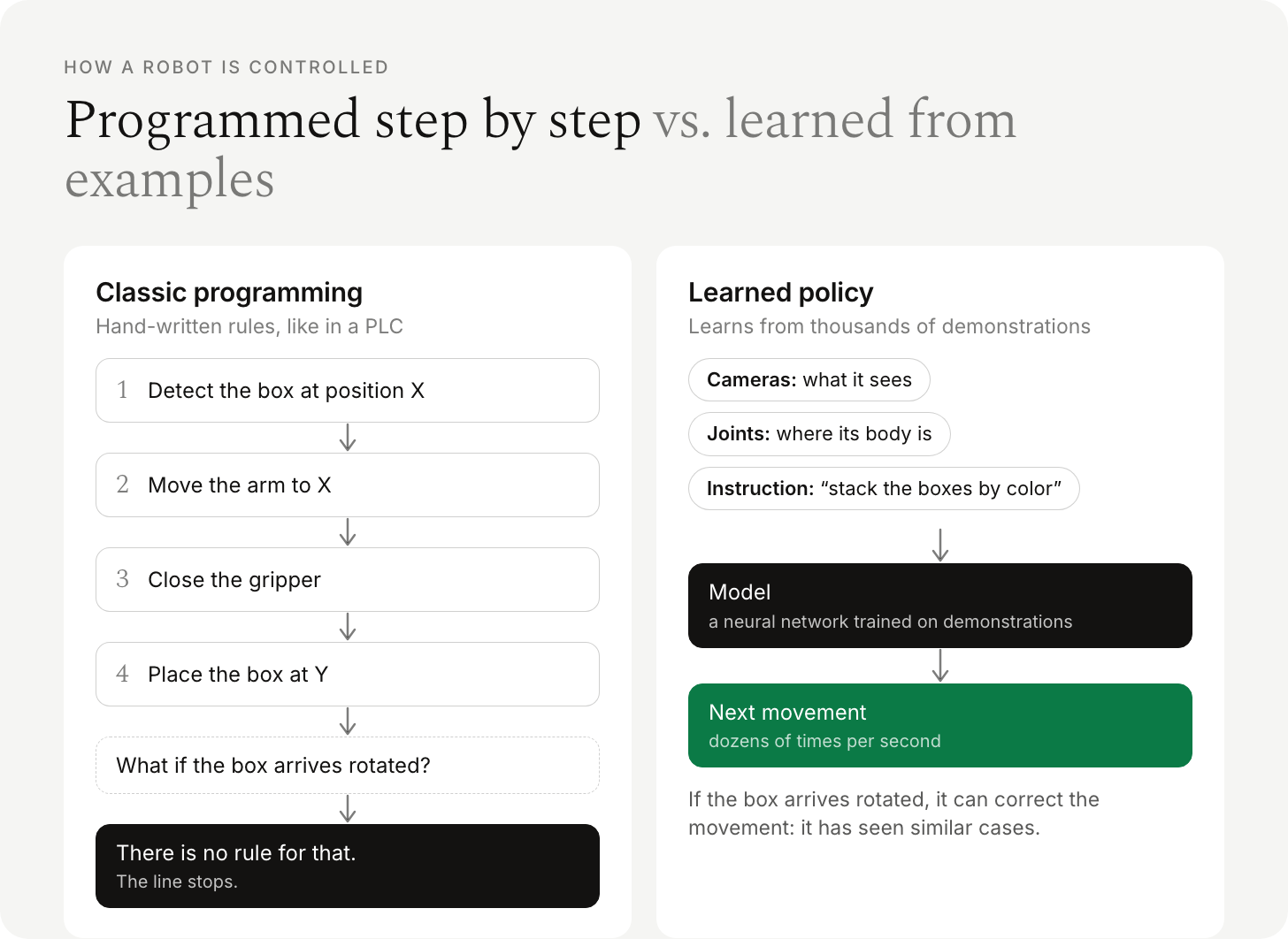
If you have ever programmed a PLC or built a circuit on a breadboard or with a Raspberry Pi, you know you have to do it as a deterministic flow. That is, a flowchart where you program step 1, step 2, step 3, and so on.
That is why current robots only work in the environment and on the task they were programmed for. Otherwise, you would have to imagine every possible case the robot will run into, and that is extremely complicated.
And while Computer Vision and Machine Learning were already used across much of the industry, those models were also specialists to some extent. Besides, in general, the models we have today are very data-inefficient: they need a huge number of examples to learn something.
We take it for granted. If we see a person do a task just once, like using a hammer to drive a nail, that is enough for us to generalize to that case, that context, and much more.
In fact, in many cases we do not even need to see it: we can imagine it or use what we call common sense. If someone tells me "stack those boxes by color," they do not need to give me an example. I know what they mean and what I have to do.
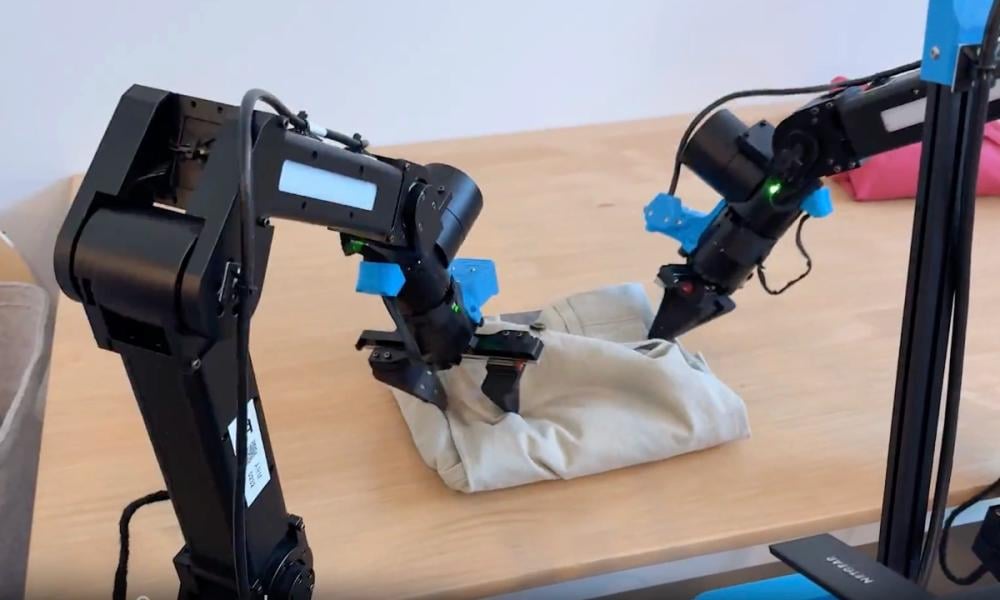
All of that, which seems very simple to us, is extremely hard to bring to robotics, and was even believed to be impossible. It has a name: Moravec's paradox. What is easy for us, like folding clothes, is incredibly hard for a machine, and vice versa.
The bet: scale the data
Going back to Scaling Laws: what happens, then, if we start collecting data on absolutely everything and train a foundation model that can generalize well across different environments and tasks?
In practice, that means replacing the rules with a policy:
A model that takes what the robot sees (its cameras), the state of its body (the position of each joint), and the instruction, and returns the next movement, dozens of times per second.
Nobody writes step 1, step 2, step 3 for it. It learns from thousands of demonstrations, almost always performed by people. This is called imitation learning.
Unlike a few years ago, there are already signs that it can work:
- In 2025, Physical Intelligence showed robots cleaning kitchens and bedrooms in homes they had never been in.
- Generalist AI trained a model on more than 270,000 hours of real manipulation data, and says it found the same thing we saw with LLMs: more data and a bigger model translate into better performance, predictably.
And of course, the money followed:
- So far in 2026, humanoid robot startups have raised more than $11 billion, more than double the record for all of 2025.
- Physical Intelligence was worth $5.6 billion at the end of 2025. There is already talk of a new round at a valuation close to $20 billion.
- 1X opened preorders for NEO, a $20,000 home humanoid, and within five days its entire first year of production was reserved.
All of that is what brings us to today's boom, in which two industries have grown: data, and the robots that use it.
The data industry
On one side are the data collection and labeling companies for robotics. Several focus on data to automate factory work: they put cameras on workers' heads to collect thousands of examples of how they perform a task, which are later used to train the model.
In India there are already textile factories where people sew with a camera strapped to their forehead.
That said, this is not the highest-quality data. The ideal is teleoperation: a person controls the robot remotely, with a suit or a virtual reality headset, and the robot records exactly what it did. But it scales much worse: for every hour of data you need an hour of a person and of a robot.
And keep in mind that robotics is not just video. A good demonstration includes, all synchronized, images from several cameras, the position of each joint, the force at the wrist and, if you are lucky, touch in the fingers. Every missing sensor is something the model has to guess.
In practice, the data looks like a pyramid. From cheapest and most abundant to most expensive and precise:
- Internet video: millions of free hours, but it does not say what force was used or what exactly the hand did.
- Head cameras: cheap and scalable, but a human hand is not a robot gripper: every movement has to be "translated" to the robot's body.
- Gloves or grippers with sensors: a person does the task with a device that mimics the robot's hand. A middle ground.
- Teleoperation: the best quality, because it is data from the robot itself. Also the most expensive and slowest.
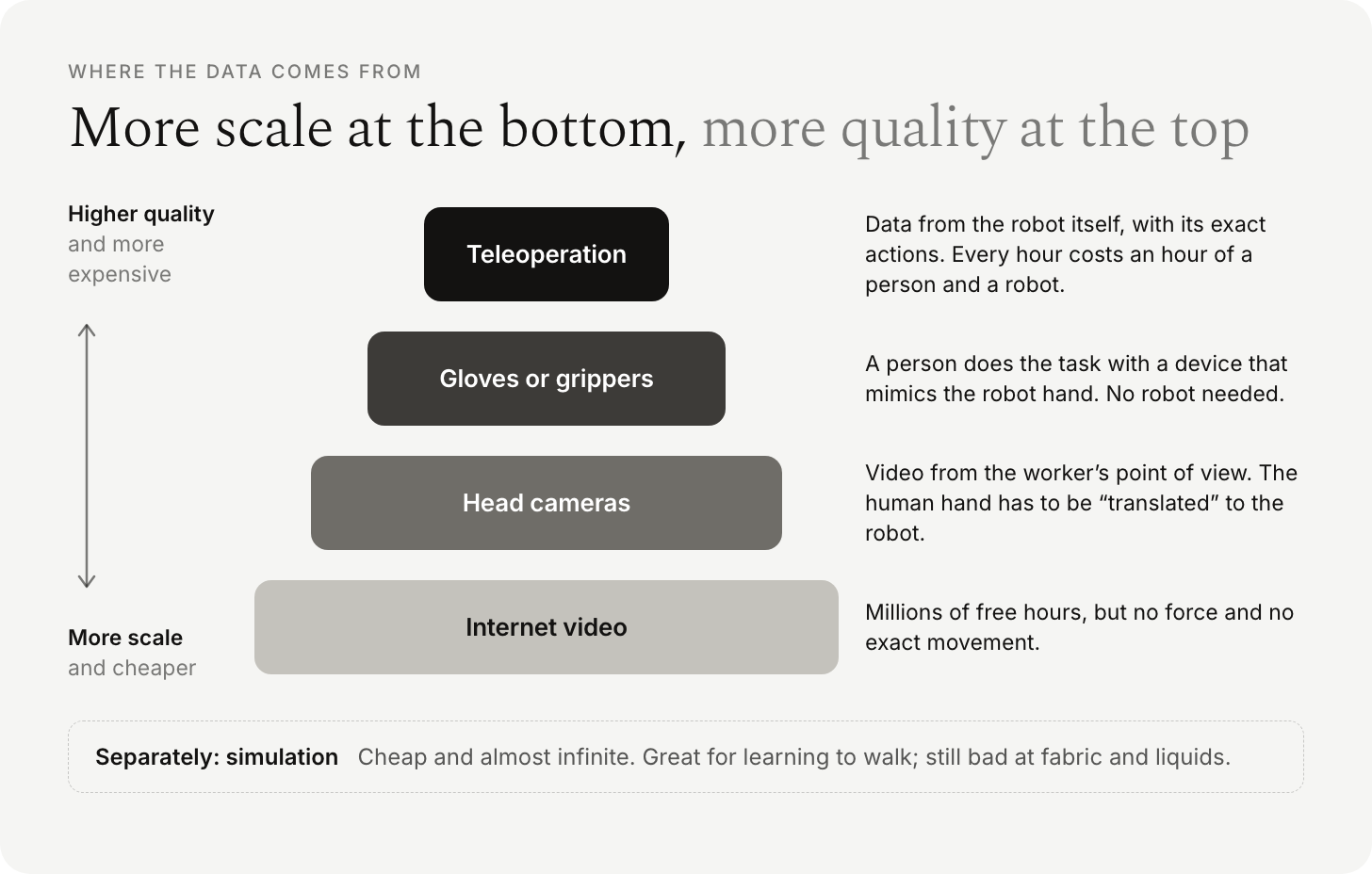
What most companies do is mix layers: lots of cheap data so the model understands the world, and a little expensive data to teach it to move precisely.
Now, a reality: often, the person wearing the camera is training the machine that could replace them, and they do not always know what their data will be used for.
The brain and body industry
On the other side are the companies that use that data: the ones building the brain and the hardware. What they want is for robots to adapt to any task, the way a person would.
Here there are also two bets:
- Those that do everything, brain and body, like Tesla with Optimus, Figure, or 1X.
- Those that only build the brain and want it to work on any robot, something like an OpenAI for robotics: Physical Intelligence, Skild AI, Generalist, or Google DeepMind with Gemini Robotics.
Does it have to look like us?
Other questions come up too. One we have debated internally: is a humanoid the best "shape" for a robot?
- One view says no: the human figure is not that efficient for many tasks. Just look at the dishwasher, which has no arms, and the robot vacuum, which has no legs.
- But on the other hand, I think we have to remember that the world is shaped for us, humans. When you walk into a house, the kitchen, the bedrooms, the closets, the bathroom, the stairs, and even the door handles are optimized for someone with a human body. That is why, in my view, designing a new kind of hardware is inefficient: with a humanoid you do not have to change how we have shaped the world.
And there is another argument in favor: data. If the robot has a body similar to ours, videos of people doing things are far more useful for it to learn from.
What is still up for debate are legs and hands. Legs climb stairs, but they also fall, use more battery, and make the robot more expensive; that is why several companies use a wheeled base with a torso and arms.
And for hands, the debate is whether to copy the human hand, which is still, by far, the hardest thing to replicate, or to stick with a gripper.
The brain: VLM, VLA, and DVA
There are different architectures for the brain. The ones you hear most about today:
- VLM (Vision-Language Model). A model that sees and understands language. You show it a photo of a kitchen, ask for the steps to clean it, and it gives them to you. But it does not move anything. In robotics it is used as the planner: it decides what to do, not how to move the arm.
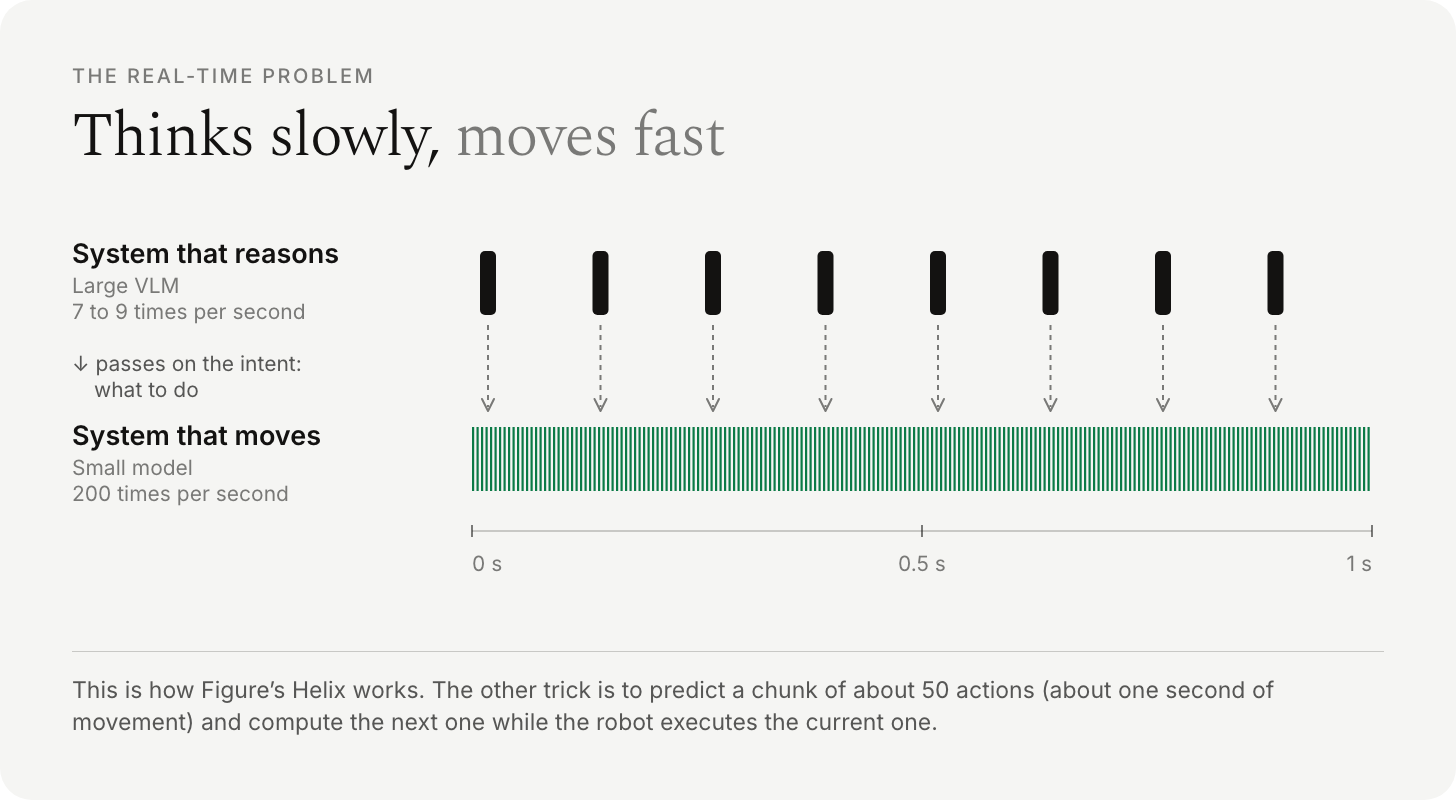
- VLA (Vision-Language-Action). It takes a VLM and teaches it to respond with actions: where to move the arm, how to turn the wrist, how much to open or close the hand. It is the dominant architecture today: it is the basis of Physical Intelligence's models, Google DeepMind's Gemini Robotics, NVIDIA's GR00T, and Figure's Helix.
- DVA (Direct Video Action). Instead of starting from a language model, it starts from a video model that learned, by watching hundreds of millions of videos, to predict how a scene will change. The robot "imagines" the next video frames, and another part of the model translates the difference between what it sees and what it imagined into the movement it needs. Rhoda AI came out this year with $450 million betting on this, and says about ten hours of robot data are enough for it to learn a new task.
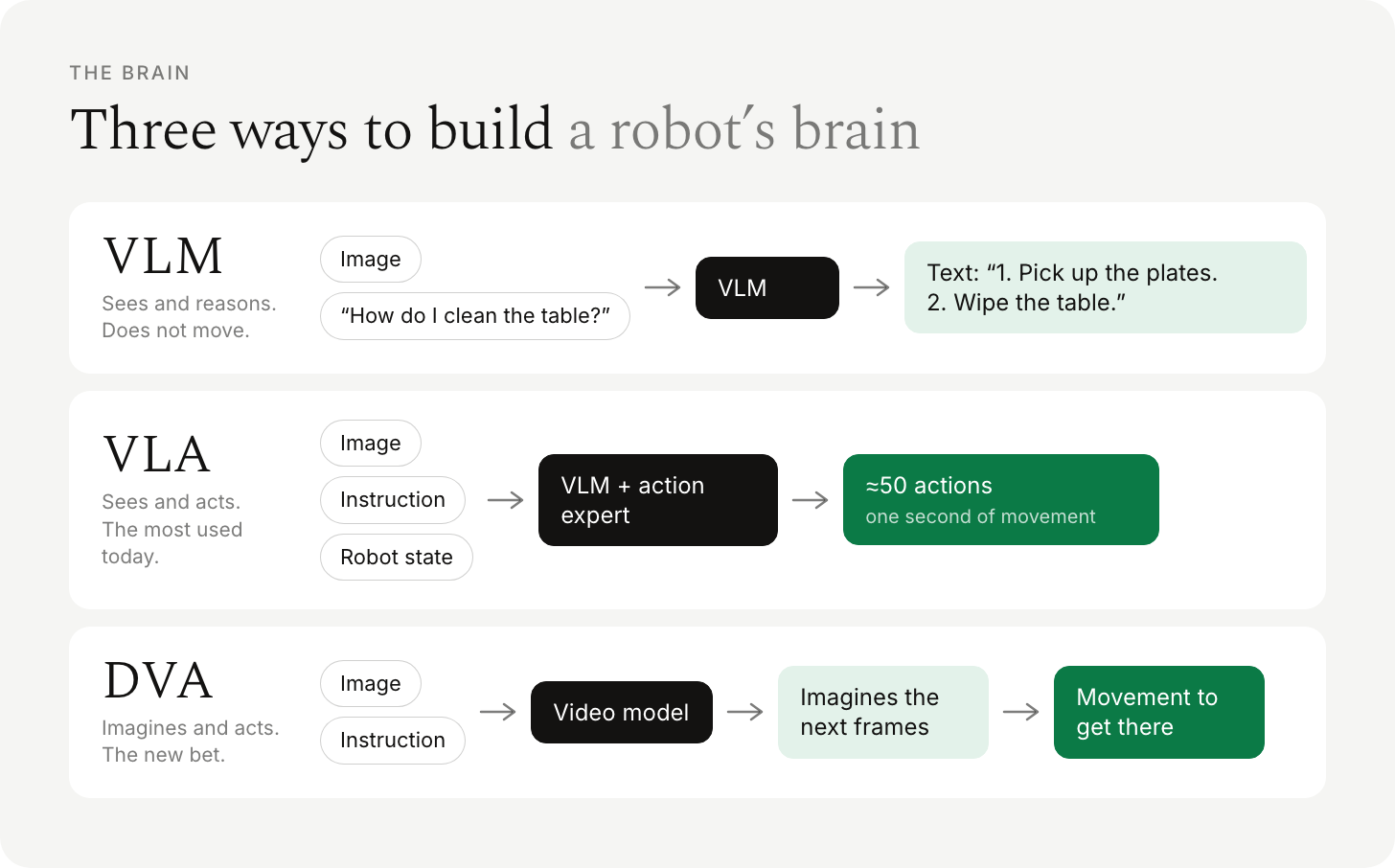
DVA is part of a bigger family, world models: models that learn how the physical world works, not how we talk about it.
The important thing is that there is no consensus. Today VLAs are ahead, but more and more people believe the path to understanding the physical world does not go through language.
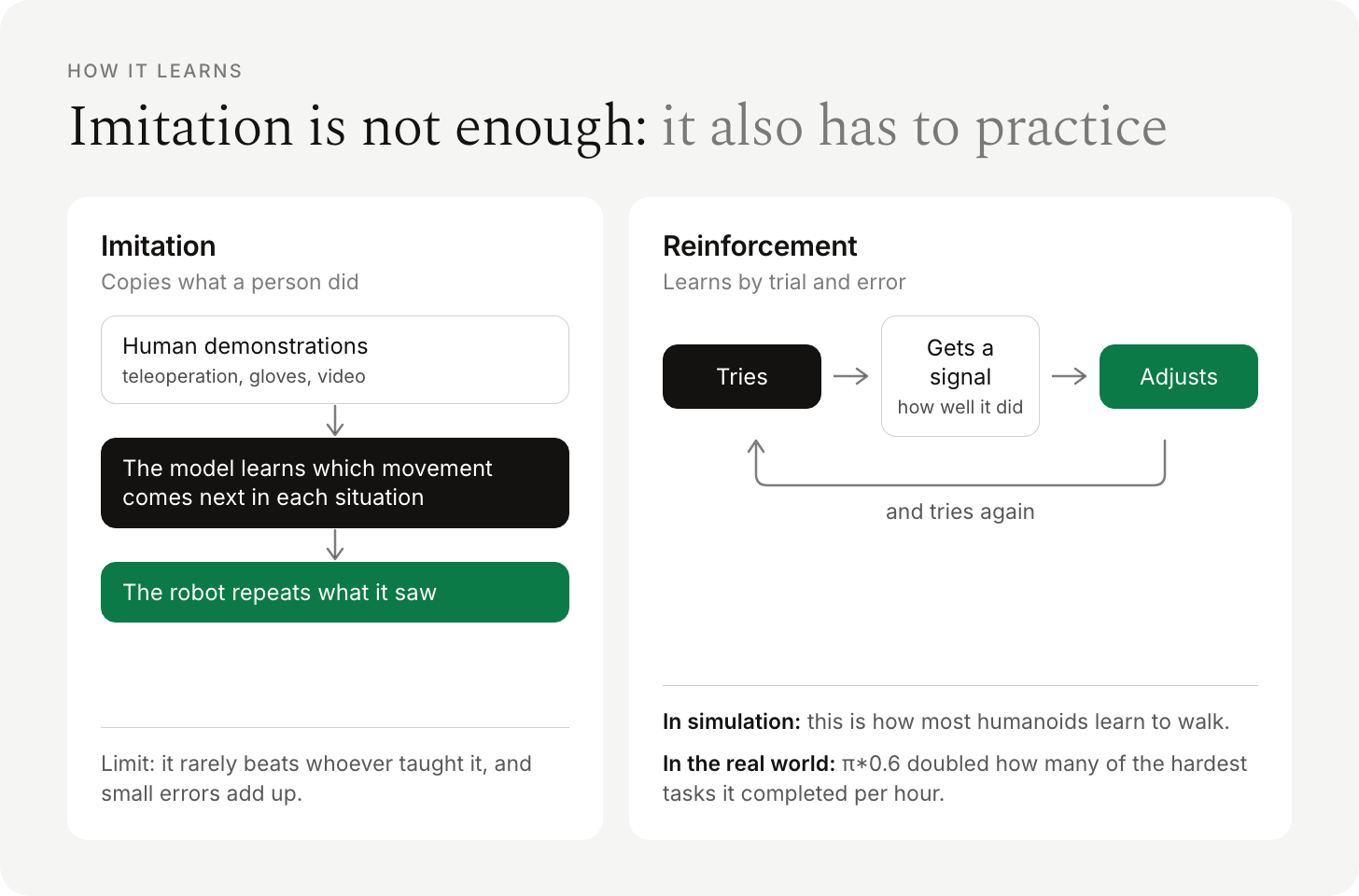
Imitation is not enough: it also has to practice
Almost everything I have told you so far is imitation learning: the robot copies what a person did. The problem is that this way it will hardly get better than whoever taught it. And when it makes a small mistake, it ends up in situations it never saw in the demonstrations, where it makes even more mistakes.
That is why the other half of the game is reinforcement learning: the robot tries, gets a signal of how well it did, and adjusts. Trial and error, the way we learn.
- In simulation, this is how most humanoids learn to walk: millions of attempts in a virtual world before taking a step in the real one.
- In the real world, Physical Intelligence showed at the end of 2025 a model that, after imitating, kept practicing with corrections from a person. On the hardest tasks it doubled how many it completed per hour, and it made espresso for 13 hours straight without interruptions.
The catch is that to practice in the real world, you need robots that already work well enough to let them do the job. It is the chicken-and-egg problem of robotics.
What I would question
So far, the why behind this hype. Now, what I would question.
1. That an LLM is the best brain for a robot
Many of these models, especially VLAs, depend on an LLM or a VLM.
That gives them common sense, but it also means they inherit their limitations:
- They know what a cup is, but they do not feel how much it weighs. They learned from internet images and text, and a photo has no weight or friction. Besides, almost none of them receive force or touch information.
- They are slow for the physical world. A robot that takes two seconds to react has already knocked over the glass.
- They hallucinate. And here a hallucination is not a wrong paragraph: it can be hitting someone.
- They are heavy to run. They have to run inside the robot, on battery and without depending on the internet. And more compute means more battery drain and fewer working hours.
2. That more data is enough
Scaling Laws worked for text because the internet already had the text. You cannot scrape the physical world: you have to go out and capture it.
There is a calculation that puts it in perspective: reading all the text an LLM is trained on would take a person about 100,000 years. Generalist's 270,000 hours, which is a huge amount for robotics, add up to about 30 years.
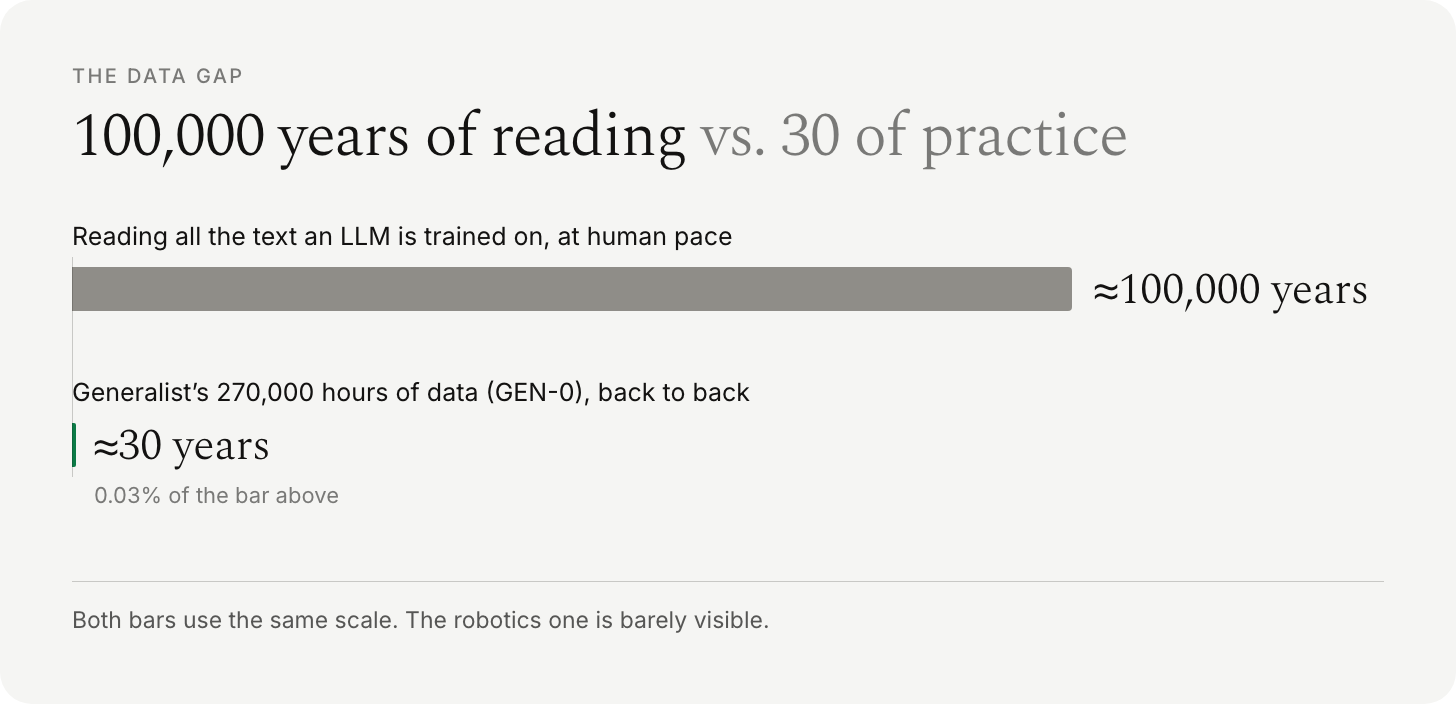
And not every hour is worth the same. For a robot to generalize, a thousand hours folding the same T-shirt on the same table teach less than a hundred hours in a hundred different homes.
And nobody knows yet how many hours of human video equal one hour of a robot doing the task.
3. That 95% is good enough
In a factory, a robot that gets it right 95% of the time, meaning it fails once every twenty times, stops the line.
Self-driving cars are the best example of how hard it is to get close to 100%: in 2005, for the first time, driverless cars finished a race of more than 200 kilometers in the desert, organized by DARPA. It took 15 years for Waymo to start offering driverless rides to the public.
4. That the numbers work, especially in Latin America
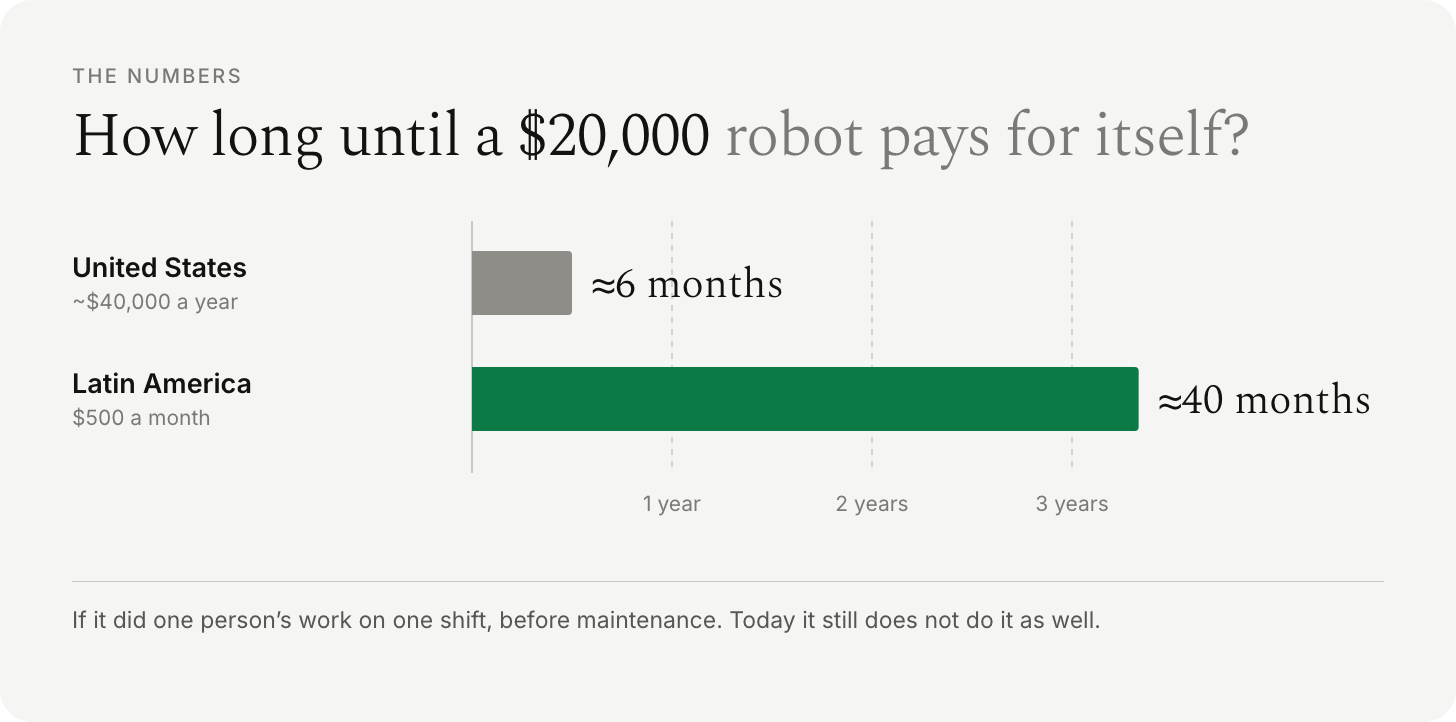
Suppose a humanoid capable of doing a person's job costs $20,000, roughly what NEO costs.
- In the United States, where a warehouse worker earns around $40,000 a year, that robot would pay for itself in about 6 months.
- In Latin America, with a salary of $500 a month, it would take more than 3 years. And that is without counting maintenance, and assuming it does the job just as well, which is not the case yet.
But that same cost advantage makes us competitive on the other side. There are already companies looking for teleoperators in Mexico, Colombia, Peru, or Brazil to remotely control robots located in other countries and generate data. For now, the opportunity for Latin America is more in training robots than in buying them.
So, is it all hype?
I do not think so. What changed is real: for the first time, the same model can do different tasks in places it has never seen, still with mistakes, without someone programming every step.
But between a demo and a robot that works every day in your home or your factory, there is a long road.