8 billion people on Earth and only 0.3% pay for AI. The opportunity is absurd.
You are not behind. You are ahead. The saturation is not in the market. It is in your feed.
You are living in a bubble.
If you spend enough time on X, LinkedIn, Hacker News, or certain corners of tech, it is easy to feel you are already late.
- A new model comes out from OpenAI, Anthropic, or Gemini.
- Another framework comes out.
- Someone says they automated half their company over a weekend.
- Someone else shows off an agent that does the work of five people.
And within minutes, the conclusion seems obvious:
"Everyone already jumped on the AI wave … except me and my company."
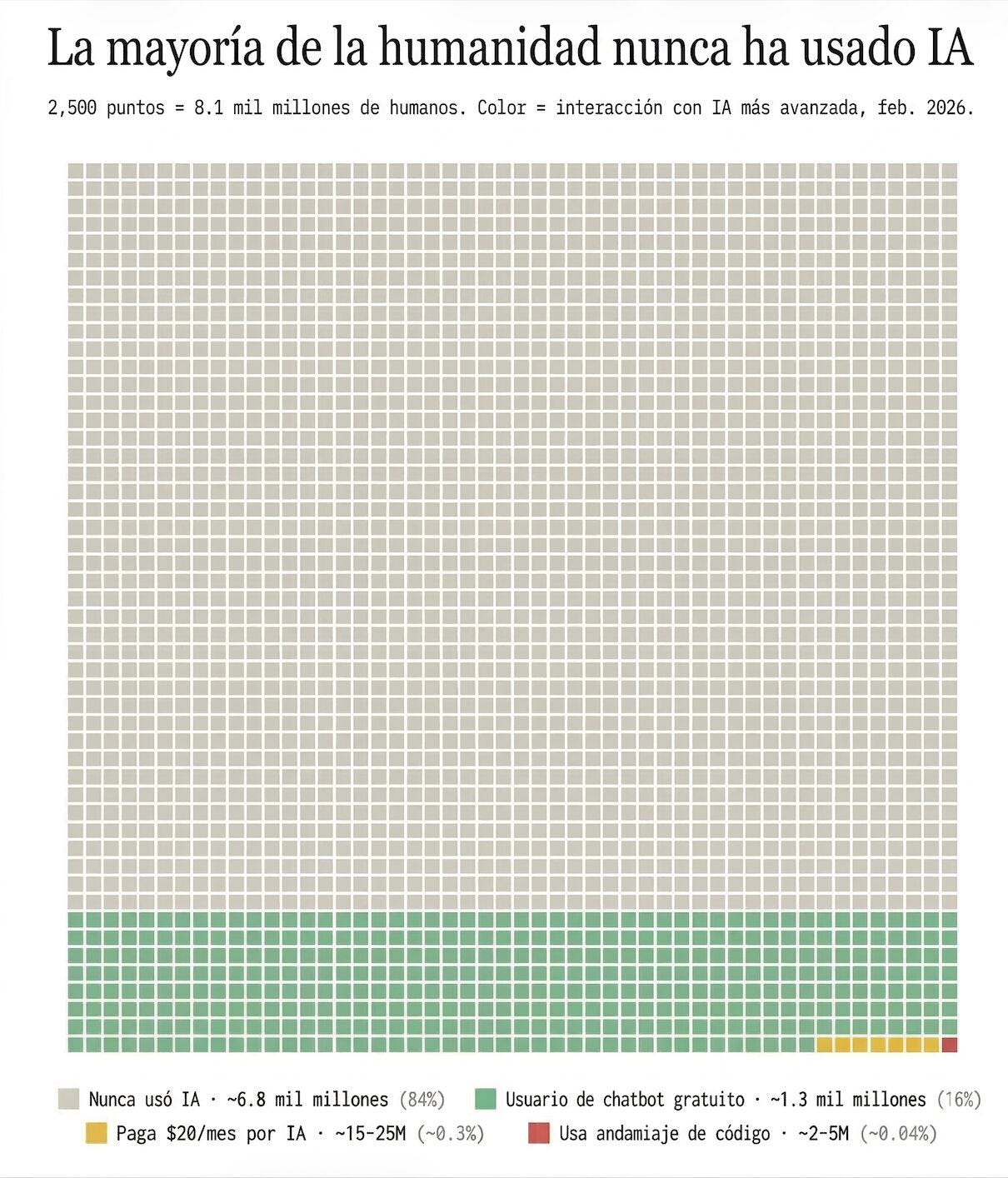
8 billion people on Earth and only 0.3% pay for AI
But that feeling has a problem: it is built on a very bad sample of the world.
The people who live obsessed with AI are a very small, very intense, very early minority. If you use that minority as your thermometer, everything will feel saturated.
The saturation is not in the market. It is in your feed.
Look calmly at the image. Each square represents about 3.2 million people. In total, the 2,500 squares represent 8.1 billion humans:
- Gray shows those who have never used AI.
- Green, those who have used a free chatbot.
- Yellow, those who pay for AI tools.
- Red, those who use AI for coding or development.
The estimates behind the visualization are brutal: around 84% of the world has never used AI, barely 0.3% pays for a tool, and only about 0.04% uses something like Cursor, Claude Code, or coding scaffold tools.
That almost invisible red dot, the one that on the internet looks like "everybody," is in reality an absurdly small minority.
Inside companies, the gap is even more absurd
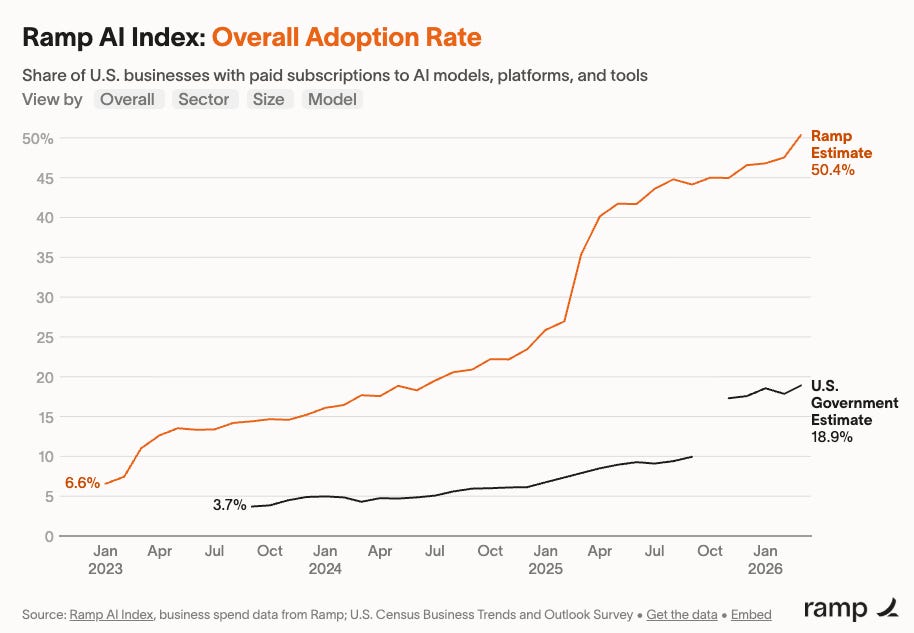
- The Federal Reserve, summarizing Census Bureau data, reported that at the end of 2025 only about 18% of US firms had adopted AI.
- On the other hand, Ramp, which measures real business spending on AI tools, estimated that 46.6% of companies were already using AI at the end of 2025, and more recently reported that in March 2026 the figure crossed 50%.
The difference between Census and Ramp depends enormously on what you mean by adoption:
If a company pays for ChatGPT Team, Copilot, or some embedded AI feature, that can show up as adoption in spending. But that still does not mean the company has a serious strategy, has redesigned how it works, or has moved beyond isolated pilots.
And this is one of the things we have seen the most in conversations with founders and executives: companies that technically already use AI, but still have no clear position on which workflow to redesign, what to buy, what to build, and which role should really change.
Do not waste this opportunity
The distance between what is already possible with AI today and what has actually been implemented in the market is still gigantic.
The internet wave created a whole generation of people who built businesses helping companies "get on the internet."
But the value you can deliver to your clients is much higher. Before, a website could cost a company a few thousand dollars and, with luck, bring a bit more visibility or traffic. Today, a good AI implementation can save a company tens of thousands of dollars a year, improve response times, increase operational capacity, or unlock revenue, and the company can see it in weeks, sometimes in days.
So stop checking social media every day thinking you are already behind.
You are not behind. You are ahead.
The window is open. It will not stay open forever. In the next three to five years this gap will shrink significantly and you will have more competitors in your sector.
So take advantage of this opportunity.